
Emission control is the part of an incinerator project that most affects compliance, permits and cost. We configure the flue gas treatment system to the standard that applies at your site.
Main Pollutants and How They Are Controlled
| Pollutant | Control method |
|---|---|
| Particulate matter (dust) | Cyclone pre-separator, bag filter |
| Acid gases (HCl, SO₂, HF) | Dry, semi-dry or wet scrubber with lime or caustic |
| Dioxins and furans | High-temperature secondary combustion, rapid quench, activated carbon injection |
| Heavy metals (e.g. mercury) | Activated carbon injection, bag filter |
| Carbon monoxide and organics | Good combustion control, temperature and residence time |
| Nitrogen oxides (NOx) | Combustion control; SNCR or SCR where required |
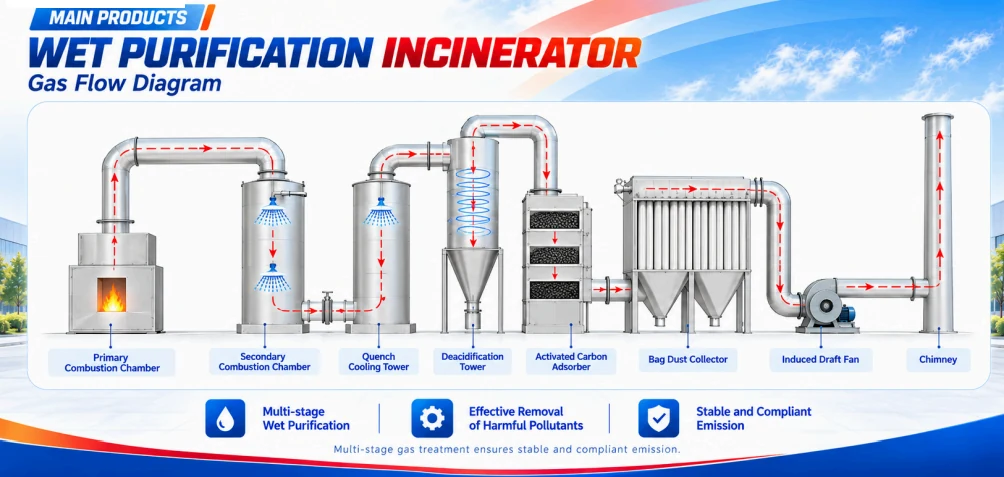
Typical Flue Gas Treatment Sequence
- Secondary combustion chamber
- Quench tower or heat exchanger (rapid cooling)
- Acid-gas scrubber
- Activated carbon injection
- Bag filter
- Induced draft fan and stack (optional continuous emission monitoring)
Our Flue Gas Purification Options
Dry purification
Compact MWI models use a purification chamber with Ca(OH)₂ filter bricks to neutralize acidic gases – suitable where local limits allow.
Wet purification: venturi scrubber + cyclone

Wet purification: multi-stage system

Choosing the Right Level of Treatment
Requirements differ by country and by waste type. Before quoting, we ask for the emission limits you must meet, then design the treatment train to match. Over-specifying adds cost; under-specifying risks failing permit tests.
Monitoring
Depending on regulations, systems can include temperature recording, oxygen and CO measurement, or a full continuous emission monitoring system (CEMS).
Get a Quote for This Project
Fill in what you know – our engineer will reply with a model recommendation and quotation, usually within 24 hours.
Get a System Designed to Your Emission Standard
Tell us your waste type, daily volume and the emission standard you must meet. Our engineers will recommend a model and send a quotation with a technical proposal.