
Pig farms produce a steady stream of mortalities – piglets, weaners, finishers and occasionally sows weighing 200 kg or more. An on-farm incinerator destroys them quickly and on site, which keeps carcasses away from scavengers and rendering trucks that may carry disease between farms.

Why Pig Farms Choose Incineration
- Biosecurity. No rendering truck visiting multiple farms. This matters especially where African swine fever (ASF) is a risk.
- Speed. Carcasses are destroyed daily rather than stored.
- Small residue. Only a small amount of ash remains.
- Control. The farm does not depend on outside collection schedules.
How to Size a Swine Incinerator
Start with your daily mortality in kg, not the number of pigs:
- Count average daily deaths by category (piglets, nursery, finishers, sows).
- Multiply by average weight.
- Add a margin for seasonal peaks.
- Check the largest single carcass – usually a sow or boar – so the door and hearth are big enough.
| Farm type | Typical daily mortality | Suggested model |
|---|---|---|
| Small farm, mainly piglets | Up to ~50 kg | SMWI-50 (50–100 kg/h) |
| Medium farrow-to-finish | 50–200 kg | SMWI-100 to SMWI-200 |
| Large farm or breeding unit | 200 kg+ | SMWI-300 to SMWI-500 |
These are starting points – we confirm the model after reviewing your figures. See our animal carcass incinerators.
Loading Large Carcasses
Sows are heavy and awkward to load. Look for:
- A wide door sized to your largest animal
- A moving hearth (manual or automatic) that pulls out for loading and ash removal
- A loading area with space for a hoist or tractor bucket

Fuel and Burn Time
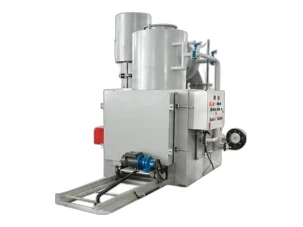
Carcasses are mostly water, so they need burner heat throughout the burn. A Canadian farm guide reports roughly 4 to 12 litres of diesel per 45 kg of carcass, depending on design and operation. Burning promptly – rather than storing carcasses – reduces fuel use. See carcass incinerator fuel and burn time.
Disease Outbreaks
During an outbreak, mortality can exceed any on-farm incinerator’s capacity. Size the unit for normal mortality plus a margin, and agree a mass-mortality plan with your veterinary authority. Discuss with us if you need a larger unit for a disease control centre.
Siting and Odour
Place the incinerator downwind of houses and barns, on a concrete base under a roof, with a clean/dirty separation so the collection vehicle does not enter the farm. A hot secondary chamber burns off odour. See siting distance and chimney height.
Get a Pig Farm Incinerator Recommendation
Tell us your herd size, daily mortality and largest carcass weight – we’ll recommend a model and loading design.
FAQ
Can a pig farm incinerator burn a whole sow?
Yes, if the door and hearth are sized for it. Tell us the weight of your largest animals so we can confirm.
How much fuel does a swine incinerator use?
It depends on carcass weight, moisture and how the unit is run. Published farm guidance suggests about 4–12 litres of diesel per 45 kg of carcass.
Does incineration help with African swine fever biosecurity?
On-farm incineration avoids moving carcasses off the farm and reduces vehicle visits, which supports biosecurity. Always follow your veterinary authority’s instructions during an outbreak.
Which fuel can the incinerator use?
Diesel, natural gas or LPG burners are available.