
Understanding how trash incinerators work helps you compare suppliers and ask the right technical questions. Most modern units follow the same five-stage process, whether they burn 20 kg or 20 tons of waste.
Looking for equipment? Compare our incinerators for sale or see our garbage incinerators, built and tested in our own factory since 2009. For large plants, see how industrial incinerators work; for the basics, start with what a trash incinerator is.

Step 1: Feeding
Waste is loaded through the furnace door by hand (batch type) or by an automatic feeding device such as a conveyor, hopper or bin-dumping lift. Automatic feeding keeps the door closed for longer, which stabilises temperature and improves safety.
Need an incinerator for garbage and household waste?
We manufacture garbage and household waste incinerators and recommend a model from your waste type, daily volume, fuel and local emission requirements. Send your details for a quotation.
Garbage IncineratorsRequest a QuoteStep 2: Gasification in the Primary Chamber
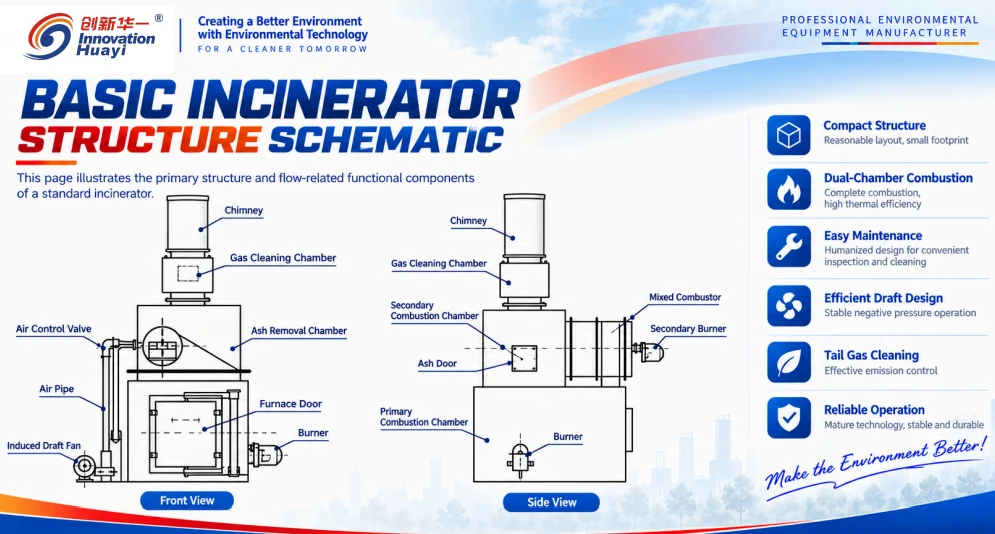
In the primary chamber, a burner ignites the waste while air is supplied in a controlled way. Temperature rises gradually from about 200°C to 800°C. This gradual heating breaks the waste down into combustible gases and reduces clinker, slagging and sintering.
Step 3: Mixing and Secondary Combustion
The gases flow into a mixing chamber, where a second burner and extra air ensure complete combustion. They then pass through the secondary chamber, where gas residence time exceeds 2 seconds and temperature can reach 1,200°C. Many regulations require at least 850°C for 2 seconds, and 1,100°C for wastes with high halogen content.

Step 4: Flue Gas Treatment
Before the gas leaves the chimney, it is cleaned:
- Dry purification: a chamber with Ca(OH)₂ filter bricks neutralises acidic gases.
- Wet purification: a venturi scrubber, packed tower and cyclone remove dust and acid gases.
- Multi-stage systems: quench tower, deacidification tower, activated carbon and bag filter for the strictest limits.
Read more in our guide to incinerator emissions control.
Step 5: Ash Removal
Bottom ash is removed from the primary chamber after each batch or continuously. Moving hearth designs make this easier for large or animal waste.
Why Furnace Wall Design Matters

A layered wall of steel, insulation cotton, insulating brick and refractory brick keeps heat inside and the outer surface below about 50°C, protecting operators and reducing fuel use.
Small Trash Incinerators vs Large Municipal Plants
Large municipal waste-to-energy plants use moving grates, boilers and complex gas cleaning, and they process hundreds of tons per day. Small trash incinerators for villages, camps and farms work on the same basic principle but in a compact, simpler form: waste is loaded in batches, burned in a primary chamber, and the smoke is burned again in a secondary chamber before passing through the chimney. This makes them practical where there is no landfill or where transporting waste is expensive.
A Typical Operating Day
- Morning check: remove ash from the previous day, check the door seals and burner
- Pre-heat: start the secondary chamber burner first so it reaches operating temperature before waste is loaded
- Loading: load sorted waste through the door, without overfilling
- Burning: the primary burner ignites the waste; the secondary burner keeps smoke burning at high temperature
- Cool down: let the furnace cool naturally before opening for ash removal
Following the same routine every day makes operation safe and keeps the chimney clean.
Tips for Clean, Efficient Burning
- Mix wet and dry waste so the fire stays strong
- Remove glass, metal and batteries where possible
- Do not overload the chamber; air must circulate
- Always pre-heat the secondary chamber
- Keep a simple logbook of loads, temperatures and fuel use
Common Problems and Easy Fixes
Black smoke usually means the secondary chamber is not hot enough or the chamber is overloaded. Slow burning usually means the waste is too wet or air supply is blocked. Excessive fuel use often comes from loading too little waste per batch or opening the door too often. Most of these issues are solved with operator training, which we provide with every unit. See our maintenance checklist to keep the machine in top condition.
Frequently Asked Questions
What temperature does a trash incinerator reach?
The primary chamber runs at about 200–800°C during gasification; the secondary chamber reaches 850–1,200°C depending on design and waste type.
Does a trash incinerator need fuel?
Yes, burners need diesel, natural gas or LPG for start-up and to maintain temperature. Dry, high-calorie waste needs less auxiliary fuel than wet waste.
See Our Incinerator Range
Compare models from 10 kg/h to 30 t/day and get a free recommendation.