
Black smoke is the number-one complaint buyers bring to us – and the number-one reason incinerators get shut down. In Rwanda, the national Auditor-General reported hospital incinerators emitting “heavy black smoke” because of low combustion temperatures, missing gas cleaning and plastic-heavy waste. In the USA, a medical waste facility in Alabama stopped its incinerator for good after neighbours complained about black smoke.
The good news: black smoke is not “normal” for an incinerator. It is a symptom of incomplete combustion, and almost every cause can be designed out before you buy or fixed in operation.
What Black Smoke Actually Means
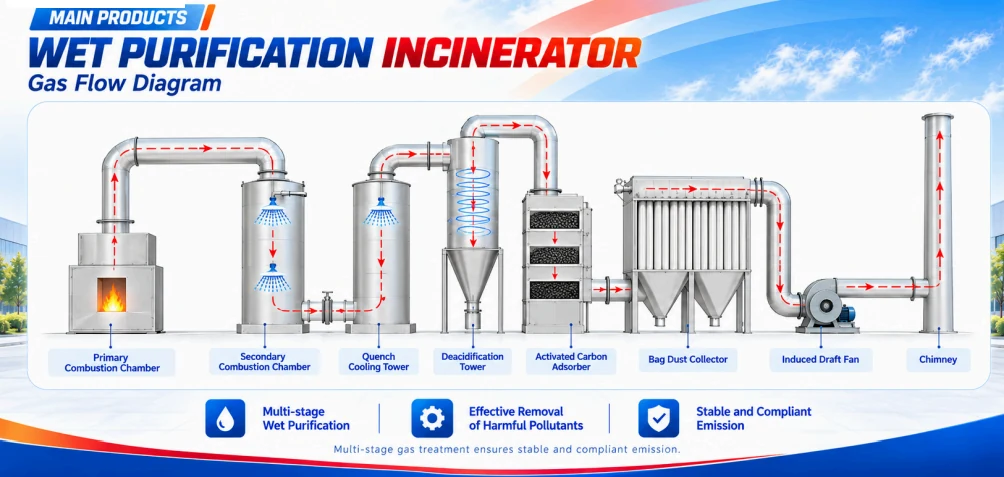
Black smoke is unburned carbon (soot) and tar. It forms when the gases released from the waste leave the furnace before they are fully burned. Full burnout needs the “3 T’s”: enough temperature, enough time (residence time) and enough turbulence to mix gas with oxygen. If any one is missing, you see smoke.
Need an incinerator for solid waste?
We manufacture solid waste incinerators and recommend a model from your waste type, daily volume, fuel and local emission requirements. Send your details for a quotation.
All IncineratorsRequest a QuoteThe 7 Most Common Causes
1. No secondary chamber, or a secondary chamber that is too small
Single-chamber “burn boxes” cannot burn off smoke. A proper incinerator has a secondary (afterburning) chamber where gases are held at 850°C or more. The EU standard is at least 850°C for 2 seconds; Ontario’s deadstock regulation accepts 1 second at 1,000°C or 2 seconds at 850°C. Ask your supplier for the secondary chamber volume and the calculated residence time – not just the temperature.
2. The secondary burner is not preheated
If waste is loaded before the secondary chamber reaches temperature, the first gases pass through cold. Always preheat the secondary chamber first, then load. A PLC-controlled unit can block loading until the set temperature is reached.
3. Overloading the primary chamber
Throwing in a full day’s waste at once releases more gas than the secondary chamber can burn. Load in batches at the rated capacity (kg/h), not by “how much fits”.
4. Too much plastic in one load
Plastics release a lot of volatile gas very fast. PATH’s Incinerator Guidebook notes that some small units can only handle 15–25% plastic per load. Mix plastic-heavy waste with paper, cardboard or other dry waste, and tell your supplier your real plastic share so the chamber and burner are sized for it.
5. Wet waste
Wet waste cools the chamber, drops the temperature below the burn-off point and creates smoky, smouldering combustion. Drain liquids, store waste under cover, and choose a model with enough burner capacity for wet loads (food waste, carcasses, placenta).
6. Too little or too much combustion air
Not enough air means unburned carbon. Too much air cools the chamber. A matched combustion-air blower and adjustable air dampers keep the ratio right.


7. Poor maintenance
Blocked air inlets, a dirty burner nozzle, a clogged fuel filter or a cracked refractory lining all reduce temperature. A weekly clean and monthly check removes most of these causes – see our incinerator maintenance checklist.
Quick Troubleshooting Table
| Symptom | Likely cause | Fix |
|---|---|---|
| Black smoke at start-up only | Secondary chamber not preheated | Preheat to set point before loading |
| Black smoke after each load | Overloading or high plastic | Smaller, more frequent loads; mix waste |
| Constant grey/black smoke | Burner or air supply problem | Clean nozzle and fuel filter; check blower |
| White smoke | Wet waste (steam) | Drain and dry waste; increase burner time |
| Smoke from doors | Negative pressure lost or worn seals | Check chimney draft and door gaskets |
How to Avoid Black Smoke Before You Buy
- Insist on a dual-chamber design with a burner in the secondary chamber.
- Ask for the residence time calculation (≥2 s at 850°C, or local standard).
- Give the supplier your real waste mix – plastic %, moisture, daily volume.
- Choose automatic temperature control (PLC) that stops loading when the furnace is too cold.
- Add a flue gas treatment system if you are near homes or must pass an emission test – see dry vs wet flue gas treatment.
- Budget for operator training. In Rwanda, insufficient hands-on training was one cause of poor performance.
Send Us Your Waste Mix – We’ll Size a Smoke-Free System
Tell us waste type, daily kg and plastic share. Our engineers will recommend the chamber size, burner and gas cleaning you need.
FAQ
Is some smoke normal when an incinerator starts?
A light haze for a few minutes during cold start can happen, but a well-designed dual-chamber incinerator with a preheated secondary chamber should not produce visible black smoke during normal operation.
Can I add a secondary chamber to my existing single-chamber incinerator?
Sometimes, but it is usually cheaper and more reliable to replace a single-chamber unit, because the gas path, burner and chimney all need to be redesigned.
Does a wet scrubber remove black smoke?
A scrubber removes particles and acid gases, but it does not fix incomplete combustion. Fix the combustion first; then use gas treatment to meet emission limits.
What temperature stops black smoke?
Most standards require the secondary chamber to reach at least 850°C with about 2 seconds residence time (1,100°C for some hazardous waste). Below this, smoke and dioxins are more likely.